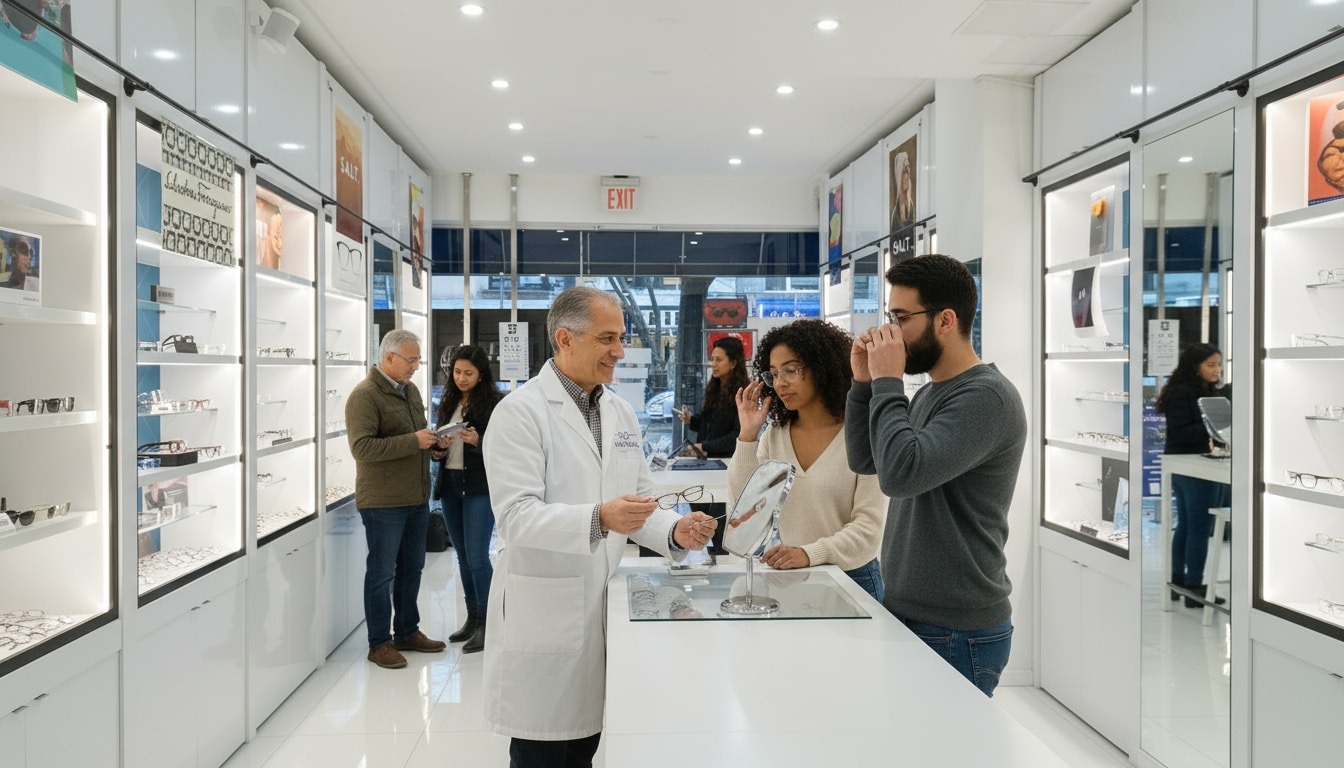
Brooklyn Resource · High-Myopia Eyewear
Strong Prescriptions Have More Options Than Most Optical Shops Will Show You in Brooklyn.
35+ years fitting high-myopia eyewear — thinner, lighter, better-looking than you were told.
Block 01
A Strong Prescription Doesn’t Mean Thick, Heavy Glasses Are Your Only Option.
High myopia eyewear in Brooklyn can be optimized — if the person fitting you knows how.
High myopia — nearsightedness with a prescription at or beyond −6.00 diopters — creates real optical challenges. Nobody’s pretending it doesn’t. But the outcome most patients live with — thick edges, heavy frames, eyes that look smaller than they are — is often the result of incomplete fitting decisions, not an unavoidable feature of the prescription itself.
Several variables directly affect how a high-myopia lens looks and feels. Most of them are controllable. Most patients with strong prescriptions have never had all of them addressed at once, in the right order, by someone who understands how they interact.
That’s what this article is about.
Block 02
Why Kings Highway Sees Some of Brooklyn’s Most Complex Myopia Cases.
Brooklyn’s demographic makeup means high myopia is common here — and the fitting demands are real.
Viewtopia Optical sits at 810 Kings Highway in the 11223 zip code. The surrounding neighborhoods — Sunset Park, Bensonhurst, Bay Ridge — have significant East Asian and South Asian communities. Both populations show clinically and epidemiologically documented higher rates of high myopia compared to the general population.
This isn’t a generalization. It’s a clinical reality reflected in the peer-reviewed literature on myopia prevalence. And it has a practical consequence: a meaningful share of the patients who walk into this practice carry prescriptions that fall into the −6.00 to −12.00 range and beyond.
Here’s what many of them have in common when they arrive: they’ve been told, directly or indirectly, that their lenses will always be thick. They’ve stopped asking whether that’s true.
After 35 years of Optical Experience, I’ve seen this enough to know it isn’t always accurate. But it does require someone willing to look at every variable — not just the prescription number.
“They’ve stopped asking whether that’s true.”
Block 03
What Determines Lens Thickness — and Which Variables Are Actually in Your Control.
Lens thickness in high myopia is shaped by at least four distinct variables — not just prescription strength.
Most patients assume the prescription number is the whole story. A stronger prescription means thicker lenses. That’s true as a baseline. But the baseline isn’t the ceiling. Here’s what actually drives the final result.
Lens Index
Lens index refers to the refractive index of the lens material — a measure of how efficiently the material bends light. Higher-index materials (1.60, 1.67, 1.74) bend light more efficiently, which means the lens can be made physically thinner while correcting the same prescription.
For a −8.00 prescription, the difference between a standard 1.50 index lens and a 1.74 high-index lens is visible and significant. It’s not subtle. One looks like a lens that belongs to a strong prescription. The other often doesn’t.
Lens Blank Diameter and Edge Thickness
This is the variable most patients never hear about. Every lens starts as a circular blank — an uncut disc of lens material. That blank has to be large enough to fill the frame’s lens opening after it’s been cut and edged.
The relationship between blank diameter and edge thickness matters for minus-power lenses. A smaller frame requires a smaller blank. A smaller blank means the edge of the lens doesn’t extend as far from the optical center, which directly reduces edge thickness in the finished lens.
In plain terms: choosing a smaller frame before ordering the lenses produces thinner edges. This step — selecting the frame first and using its dimensions to specify the blank size — is something that gets skipped in high-volume settings where frame choice and lab orders are treated as separate steps.
Frame Geometry for Optical Centering
In a minus-power lens, the center is thinnest. The edge is thickest. Getting the optical center — the point in the lens that aligns with the center of the pupil — correctly positioned minimizes the lens area that’s working hardest and thickest.
When the frame shape and size don’t support good optical center placement, the finished lens shows more thickness than the prescription mathematically requires. Correct frame selection and precise measurement of pupillary distance (the gap between the centers of both pupils) work together. One without the other leaves results on the table.
Aspheric Lens Design
Aspheric lens design means the lens surface has a flatter, more gradual curve than a traditional spherical lens. This produces two benefits in high-myopia lenses: reduced distortion at the edge of the lens, and a more cosmetically flattering profile. Aspheric lenses also reduce the minification effect — the apparent shrinkage in eye size caused by strong minus-power concave lenses. The minification effect can be reduced through aspheric designs and precise fitting, though not fully eliminated. Being honest about that with a patient before they order is part of the consultation.
Block 04
When Chains Default to Standard Index and What Gets Left on the Table.
High-volume optical retail is built for efficiency — and complex prescriptions need more than an efficient process.
Here’s what a typical high-volume optical experience looks like for a patient with a −9.00 prescription.
They’re offered a lens package. The package includes high-index as an upgrade. Sometimes they’re told what index that is. Often they aren’t. The frame selection happens on the sales floor, with no one measuring the frame’s lens dimensions before the order is placed. Nobody discusses blank sizing.
The patient picks a frame they like from what’s available. The order goes to the lab. The lenses come back. They’re thicker than the patient hoped — and the answer, if they ask, is usually some variation of “that’s just how it is with your prescription.”
What actually happened: the frame may have been too large, requiring a larger blank, producing thicker edges. The index selected may have been 1.60 when 1.74 was indicated. The optical center placement may not have been verified. Any one of those gaps produces a worse cosmetic result. All three together produces the outcome that becomes the patient’s baseline expectation for the next pair.
This is why patients arrive at Viewtopia having accepted thick lenses as a fact. It wasn’t a fact. It was an incomplete fitting.
Block 05
How I Approach a High-Myopia Fitting Differently Than a Standard Prescription.
Abe Zami · ABO-NCLE Certificate #018067 · NYS Optician License #005762-01
Every high-myopia fitting at Viewtopia starts with the frame, not the lens order.
I’ve been fitting high-myopia prescriptions for over 35 years. In that time, I’ve worked with prescriptions ranging from −6.00 to beyond −14.00. The technical details vary. The underlying approach doesn’t.
The first thing I do is look at what the patient is wearing, if they’re wearing anything. I’m evaluating frame size, optical center position, edge thickness, and what the lens design tells me about what index was used. Before I say anything about new glasses, I want to understand what they currently have.
Then we talk about frame selection before I touch anything else. I’m looking at the frame opening size, the shape, the position relative to the face, and whether a smaller option would serve the prescription better cosmetically without sacrificing the look the patient is after. Sometimes a few millimeters of frame reduction makes a visible difference in edge thickness. That conversation happens before any lens is discussed.
From there, I select the appropriate index. For prescriptions beyond −6.00, I’m typically working with 1.67 or 1.74. The decision depends on the exact prescription — sphere, cylinder, and axis all factor in — and on what the patient’s priorities are for weight versus thickness.
Then the measurements: monocular pupillary distance (each eye measured independently, not estimated from a single total), vertex distance (the gap between the back of the lens and the front of the cornea), and pantoscopic tilt — the slight downward angle of the frame’s lens plane relative to the eye, which affects where the optical center lands. All taken in the actual frame the patient will wear. Not estimated. Not assumed.
The order doesn’t go to the lab until all of those decisions are made together. That’s not a slower process. It’s the right process.
“Not a slower process. The right process.”
Block 06
If Your Lenses Have Never Felt Right, It May Be a Fitting Issue, Not Your Prescription.
Persistent discomfort with a high-myopia prescription often points to a fitting gap — and fitting gaps can be corrected.
There’s a specific experience that high-myopia patients describe with some regularity. They’ve had their prescription checked. It’s accurate. The optometrist confirmed it. But the glasses still don’t feel quite right. Something’s off — peripheral distortion, eye strain that sets in by afternoon, or a sense that the world isn’t quite where it looks like it should be.
This is worth investigating.
A few specific possibilities deserve attention. First, incorrect monocular pupillary distance — if both eyes’ optical centers were set using a single total PD measurement rather than measuring each eye independently, the centering may be slightly off. For high prescriptions, small centering errors create effects that are easy to feel but hard to name.
Second, the wrong index for the prescription weight. A very strong prescription in a lower-index material is physically heavier, which can shift the frame position over the course of a day. That shift moves the optical centers gradually away from the pupils.
Third, vertex distance mismatch. If new glasses were made with different lens-to-eye dimensions than those present during the prescribing exam, the effective power the eye receives can differ from what was prescribed — even when the numbers on the prescription are correct.
These are real causes of real discomfort. They can be assessed, identified, and corrected in a fitting that addresses each variable properly.
Block 07
High-Myopia Specialist Eyewear Available to Brooklyn and NYC Patients.
VIEWTOPIA Optical serves patients across Brooklyn and the greater New York City area.
810 Kings Highway is accessible from across southern Brooklyn — including Gravesend, Sheepshead Bay, Midwood, Bensonhurst, and Bay Ridge. The B and Q subway lines stop directly at Kings Highway station, and multiple MTA bus routes serve the corridor.
Patients from Sunset Park and Bay Ridge visit for complex prescription fittings. So do patients from other parts of Brooklyn and the broader NYC area who haven’t found a satisfying result elsewhere.
No appointment is required. Walk in during business hours.
Block 08
Schedule a High-Prescription Consultation at 810 Kings Highway.
If your strong prescription has never produced lenses you were genuinely satisfied with, the consultation is the right starting point.
Bring your current prescription. Bring your existing glasses if you have them. Abe Zami will assess what you’re working with, explain what’s achievable with your specific Rx, and walk through the fitting decisions together before anything is ordered.
Walk in to 810 Kings Highway, Brooklyn, NY 11223.
No online ordering. No packages. A 35-year specialist who looks at your prescription and your face — and figures out what your lenses can actually be.