I’ve been fitting high-myopia prescriptions for over 35 years. In that time, I’ve worked with prescriptions ranging from −6.00 to beyond −14.00. The technical details vary. The underlying approach doesn’t.
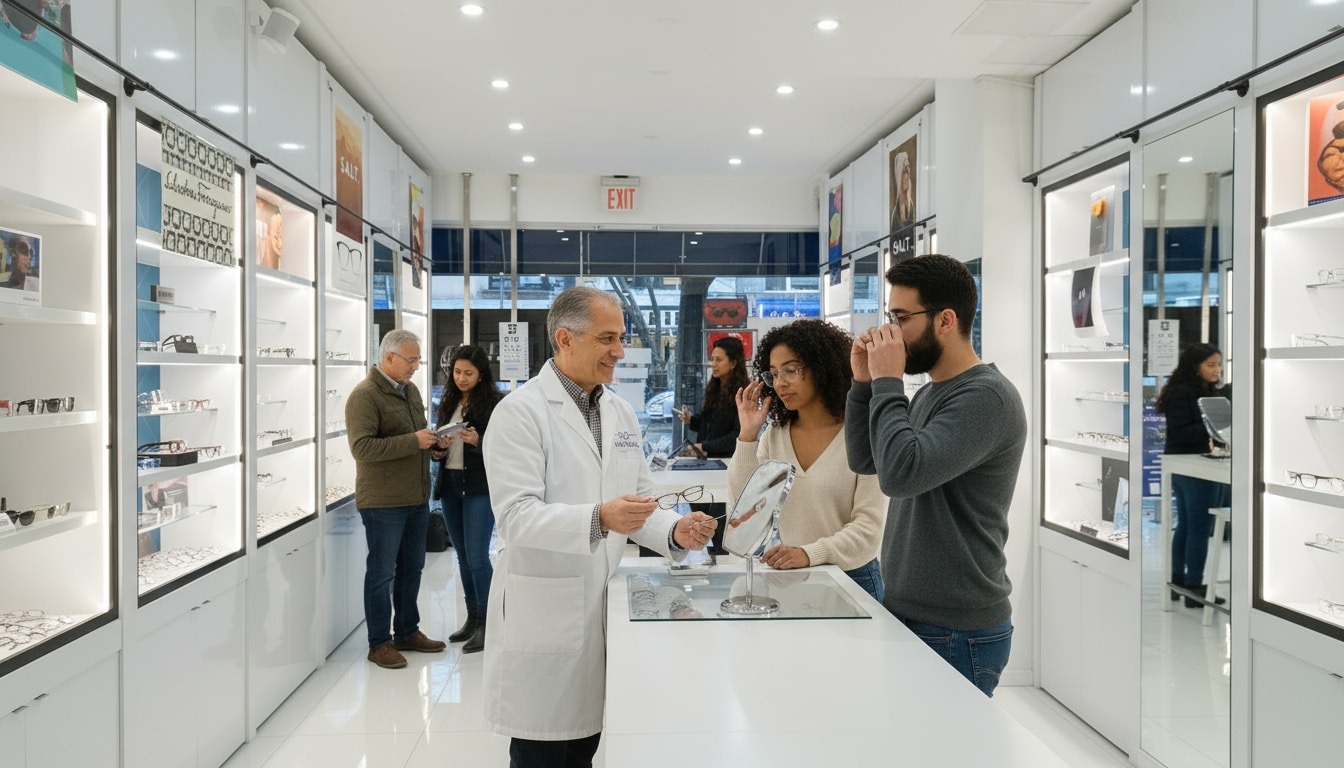
The first thing I do is look at what the patient is wearing, if they’re wearing anything. I’m evaluating frame size, optical center position, edge thickness, and what the lens design tells me about what index was used. Before I say anything about new glasses, I want to understand what they currently have.
Then we talk about frame selection before I touch anything else. I’m looking at the frame opening size, the shape, the position relative to the face, and whether a smaller option would serve the prescription better cosmetically without sacrificing the look the patient is after. Sometimes a few millimeters of frame reduction makes a visible difference in edge thickness. That conversation happens before any lens is discussed.
From there, I select the appropriate index. For prescriptions beyond −6.00, I’m typically working with 1.67 or 1.74. The decision depends on the exact prescription — sphere, cylinder, and axis all factor in — and on what the patient’s priorities are for weight versus thickness.
Then the measurements: monocular pupillary distance (each eye measured independently, not estimated from a single total), vertex distance (the gap between the back of the lens and the front of the cornea), and pantoscopic tilt — the slight downward angle of the frame’s lens plane relative to the eye, which affects where the optical center lands. All taken in the actual frame the patient will wear. Not estimated. Not assumed.
The order doesn’t go to the lab until all of those decisions are made together. That’s not a slower process. It’s the right process.