Strong Prescriptions Deserve Lenses Optimized for Thickness, Weight & Appearance
35+ years fitting high-myopia eyewear in Brooklyn — including prescriptions many patients assumed couldn’t be thinned. Walk in to 810 Kings Highway, no appointment needed.
You've been told nothing can be done. Maybe more than once. It doesn't have to be that way.
If you’ve worn thick-edged lenses for years and assumed that’s just what your prescription looks like on your face — high-index lenses, specific frame sizing, and precise optical centering can change the appearance of your glasses significantly. Not magic. Not a miracle. But real, measurable improvement that many patients with strong prescriptions have never been shown.
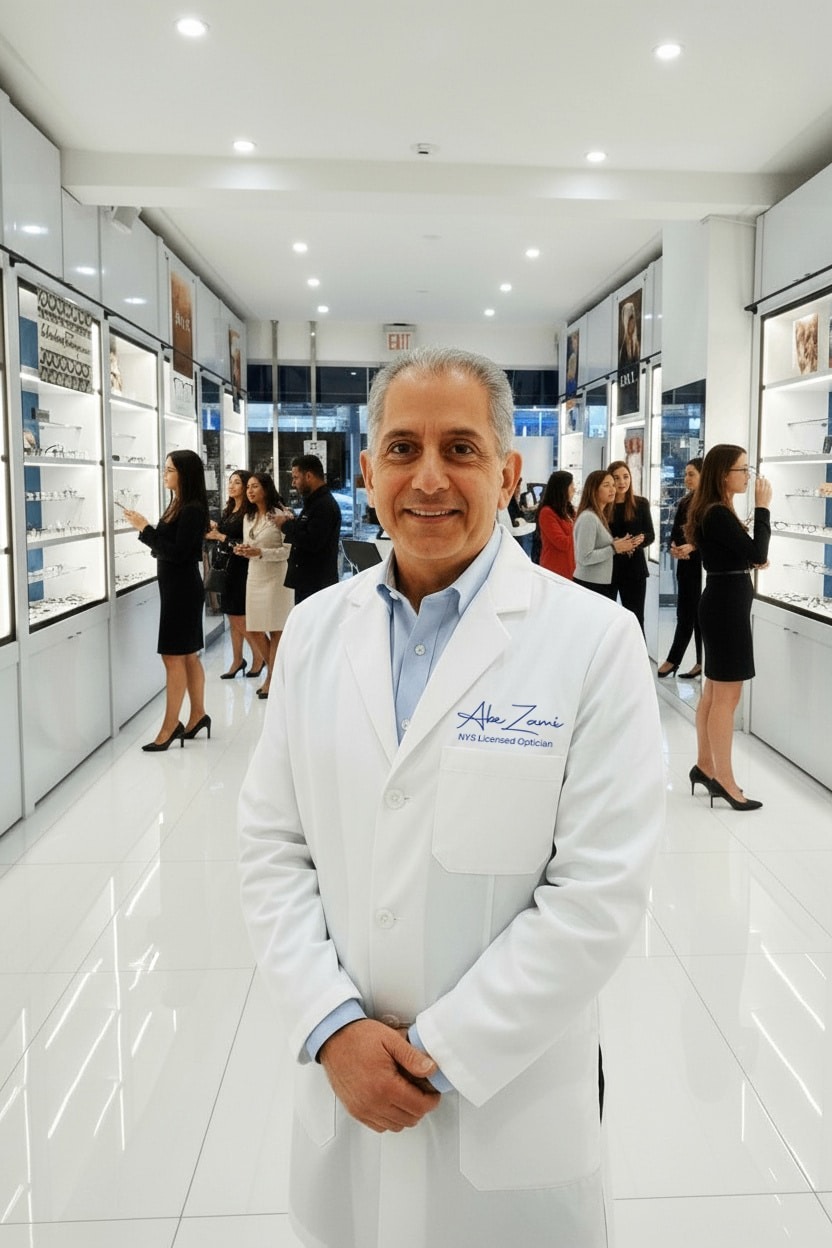
Abe Zami has been optimizing high-prescription eyewear at Viewtopia Optical for over 35 years. High-prescription fitting is his primary area of expertise — the one place where accumulated experience matters most.
The Kings Highway corridor shapes who walks through the door — and what their prescriptions look like.
Kings Highway sits at the intersection of several Brooklyn communities with clinically elevated rates of high myopia. East Asian and South Asian populations — well-represented throughout Bensonhurst, Borough Park, and the surrounding corridor — experience high myopia at significantly higher rates than the general population.
Many of these patients arrive after visiting multiple optical shops — handed thick lenses and sent home with glasses that never quite looked or felt right. Their prescription is genuinely difficult. What changes here is the approach: index selection, frame geometry, and optical centering treated as one decision, not three separate afterthoughts. If your prescription also calls for multifocal correction, see the progressive lenses page — for general prescription work, the prescription eyeglasses page covers the standard fitting process.
Fitting high-myopia eyewear in this same corridor
Authorized to dispense in New York State
National opticianry & dispensing competency
Lens thickness is not dictated by prescription power alone.
Three variables determine how thick your lenses will be. The prescription number is only one of them. All three have to be addressed together — in the right order — before the lab order is placed. When they are, the result is a noticeably different pair of glasses.
The material that bends light
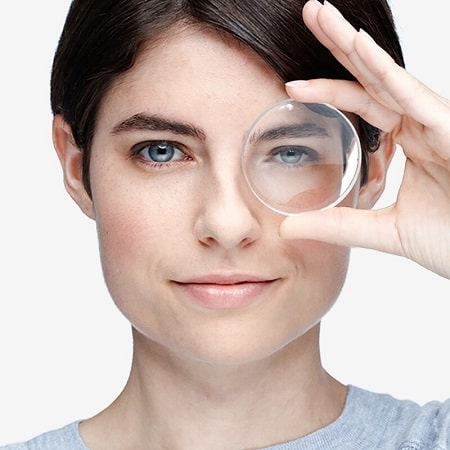
Refractive index is the material’s ability to bend light efficiently. A higher index — 1.60, 1.67, or 1.74 — bends the same amount of light using less material. The lens is thinner and lighter for the exact same prescription. Standard 1.50 produces the thickest result for a strong prescription.
Smaller frame, less edge thickness
The edge thickness of a minus-power lens — the thick part at the rim — grows larger as the lens blank gets wider. A smaller frame requires a smaller blank. Smaller blank means less edge thickness, every time. The frame you choose directly changes how thick your lenses will be. This is physics, not preference.
Pupil-to-center precision
How precisely the lens’s optical center is aligned with your pupil. At high prescription powers, even a small misalignment produces visible prismatic distortion. Getting this right requires an in-person measurement. It cannot be approximated from a chart or estimated from a previous pair.
If you’ve been told nothing can be done for your prescription, bring it in and bring your current glasses. The center thickness, edge profile, and minification of your current pair tell the story before any measurements are taken.
If the lens is ordered first and the frame chosen second, the most powerful cosmetic tool available is already gone.
The blank diameter specified on the lab order depends on the frame dimensions. Most patients with a strong prescription don’t realize the frame has to be selected before the lens order is placed. That sequencing is the part that changes outcomes.
Index selection, frame sizing, and optical centering — as one decision, not three afterthoughts.
At Viewtopia, every high-prescription order follows a specific sequence. That sequence is what controls the outcome — and it’s not negotiable.
Prescription Review First
Abe examines the sphere, cylinder, and combined prescription value to determine the appropriate index material. For most prescriptions above −5.00 with significant cylinder, 1.67 is the minimum. At −8.00 and above, 1.74 is assessed. Bring your current glasses if you have them — the edge profile of your existing lenses tells part of the story.
Frame Selection — Based on Optics
Frame shape, lens depth, and overall width are evaluated against the prescription. Smaller, rounder frames reduce blank diameter and edge thickness directly. The frame is chosen for the prescription, not just for appearance — though the right frame can accomplish both.
Measurements Taken In The Chosen Frame
Monocular pupillary distance is measured with the patient wearing the selected frame — never as a single binocular number. Pantoscopic tilt and vertex distance are assessed in the frame you actually chose. These measurements go to the lab with the order, not estimated from a standard chart.
Aspheric Design Selected Where Indicated
Aspheric designs use a flatter, more gradual lens curve to reduce the minification and distortion visible in high-power prescriptions. Applied correctly, they produce a cosmetically superior result and noticeably better peripheral clarity.
Lab Order Specified Completely
Every parameter is documented before the order leaves this location. No variables are assumed. No defaults are accepted when a patient-specific measurement is available. Coatings are recommended deliberately based on how the patient actually uses their glasses.
Final Fitting & Verification
When the lenses return, optical center alignment is verified, the frame is adjusted to final position, and the pantoscopic tilt is confirmed against what was measured. The fitting doesn’t end when the glasses come back from the lab — it ends when the patient can see correctly and the lenses are sitting where they should.
The goal is optimization, not invisibility. A very strong prescription will still produce some visible edge thickness — but how much is far more controllable than most patients have been told.
Three phases — exactly what happens when you walk in.
From your first walk-in with a prescription through verified pickup, every high-prescription fitting at 810 Kings Highway follows the same path. No appointment is required — the consultation can happen the day you arrive.
Initial Consultation
You arrive with your current prescription. Abe reviews the sphere, cylinder, and axis values together — confirming whether the prescription is within the range optimizable with high-index materials and which index is appropriate for your specific numbers.
If you have previous glasses, bring them. The way your current lenses look tells part of the story before any measurements are taken. Center thickness, edge profile, and minification all inform the recommendations for the next pair.
Frame & Lens Selection
Frame selection happens here — in this order: geometry first, aesthetic second. Abe identifies the frame dimensions that reduce blank diameter for your prescription range. Within those parameters, you choose the frame that suits you.
Lens material and design are selected together with the frame. Aspheric design is assessed at this stage, not added as an afterthought. For patients who have never worn aspheric lenses, the difference in peripheral clarity is often noticeable within the first day.
Measurements, Lab & Pickup
Monocular PD, segment height if applicable, pantoscopic tilt, and vertex distance are measured with your chosen frame in place. Nothing is carried over from a previous pair. Every measurement is taken fresh for every order.
When the lenses return, they’re checked against the prescription before you’re called. At pickup, Abe verifies optical center alignment, adjusts the frame to final position, and confirms the pantoscopic tilt matches what was measured.
Find us on Kings Highway.
Steps from the Kings Highway B and Q station, in the heart of southern Brooklyn. No appointment needed — walk in with your current prescription during business hours.
810 Kings Highway
Bet. East 8th & 9th
Brooklyn, NY 11223
Monday – Wednesday10:00 AM – 6:00 PM
Thursday10:00 AM – 7:00 PM
Friday10:00 AM – 1:00 PM
SaturdayClosed
Sunday11:00 AM – 5:00 PM
Gravesend · Midwood · Bensonhurst · Sheepshead Bay · Flatbush · Bay Ridge · Manhattan
Find out what's actually achievable
for your specific numbers.
Bring your current prescription — or your current glasses if you have them. Abe will review the numbers, explain what the index options can realistically produce, and walk through the frame selection process in one visit. Nothing is ordered until the measurements are taken correctly and the frame geometry is confirmed.
Call 718-676-0260 or walk into 810 Kings Highway, Brooklyn, NY 11223. No appointment needed.
NYS License #005762-01 · ABO-NCLE Certificate #018067
Frequently
asked.
Common questions about high-index materials, frame compatibility, aspheric design, and what’s realistically achievable for strong prescriptions. If your question isn’t here, call or walk in.