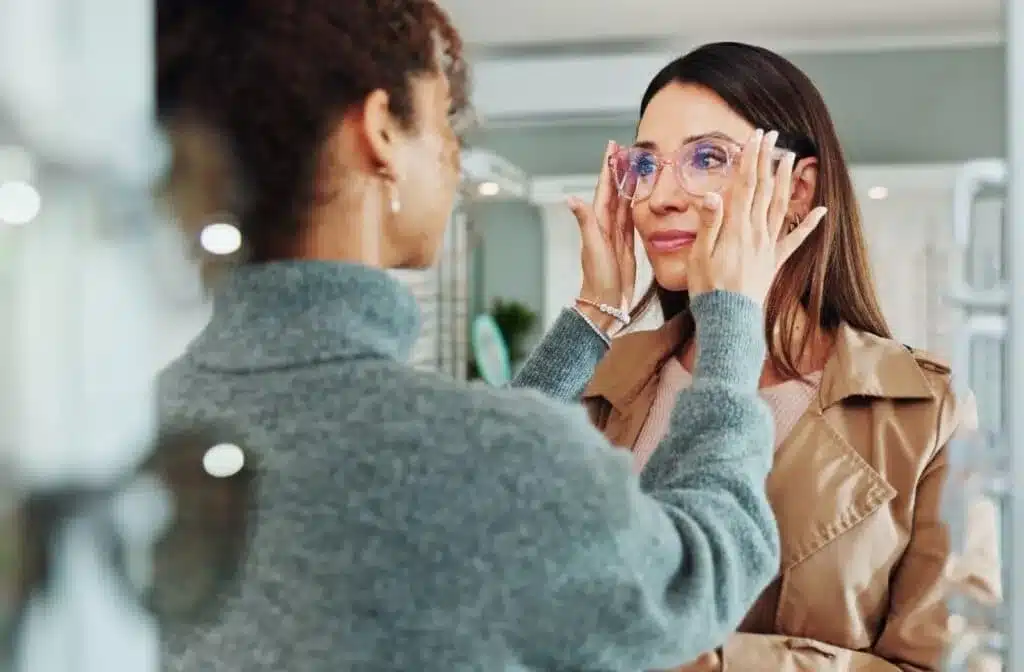
Woman wearing pink-tinted eyeglasses with hands near the frame during a fit check

Viewtopia Optical

Progressive Glasses Recheck: What to Record Before You Return

A few specific observations about daily tasks and frame movement can help make a follow-up visit more useful. You do not need to identify the cause yourself.

Abe Zami

Get in touch

Before a progressive glasses recheck, record the task, approximate viewing distance, where you looked through the lenses and what felt wrong. Note whether the problem repeats and whether the frame shifts while you wear it.

At Viewtopia Optical in Brooklyn, we use selected-frame measurements and finished-lens verification as part of progressive dispensing. Your observations add something different: how the glasses behave during the activities you need them for.

What should you record before a progressive-glasses recheck?

Keep short notes about specific moments rather than trying to diagnose the glasses. A progressive recheck can involve several factors, so a clear description is more useful than deciding in advance that the prescription or fitting must be wrong.

  • The task: Name what you were doing, such as reading a book, using a desktop monitor or looking across a room.
  • The distance: Estimate how far the page, screen or object was from your eyes. A rough description is useful if you did not measure it.
  • Where you looked: Note whether you were looking straight ahead, down through the lower lens or toward the side. You do not need to identify a technical lens zone.
  • What felt wrong: Describe blur, a small clear area or a head position that felt awkward for the task.
  • Whether it repeats: Note whether the same difficulty happens each time or only under certain conditions.
  • Frame movement: Record whether the glasses slide, tilt or seem to sit differently as you work.
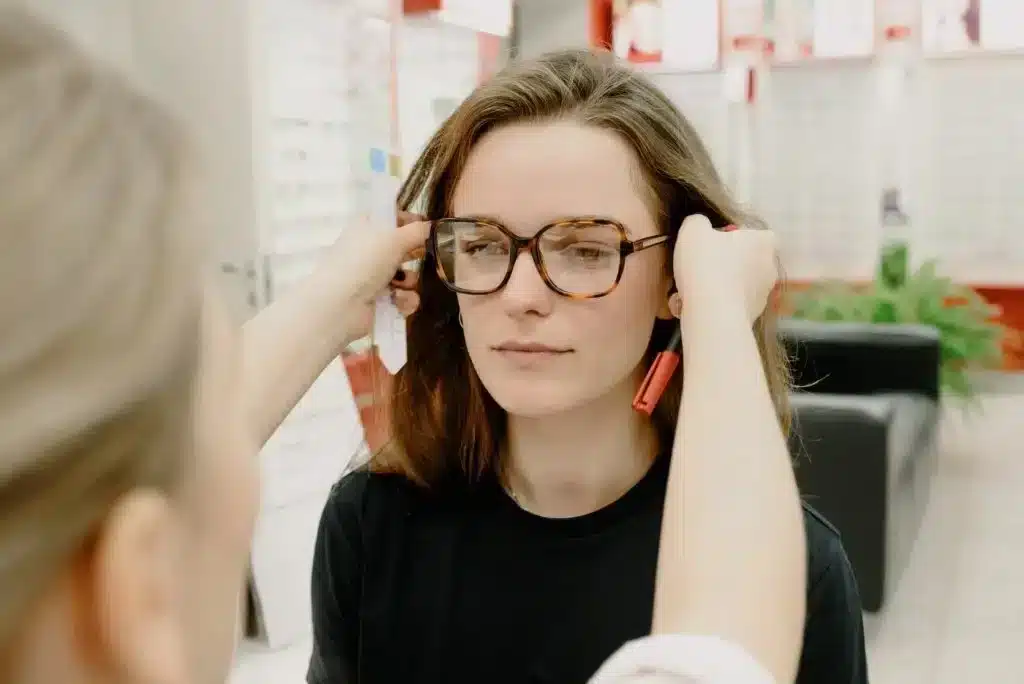
Woman wearing tortoiseshell-frame glasses while the frame is adjusted near her temples

Which everyday viewing tasks should you describe?

Separate distance viewing, computer work and close reading in your notes. Progressive lenses provide different powers across the lens, so difficulty with a monitor does not necessarily describe what happens with a book or a distant object.

TaskViewing situationUseful observation
Distance viewingAcross a room or farther awayWhat looks blurred when looking ahead
Computer or intermediate workAt your usual screen distanceHow much of the screen is usable and your head position
Close readingA book, phone or other nearby textWhere you hold the text and look through the lens

How do you describe the problem without guessing at the cause?

Describe what you can observe, not which part you think needs replacing. Blur, a narrow usable area, an unexpected head position and a shifting frame are useful clues, but none proves a prescription, lens-design or fitting error by itself.

For example, you might report that the center of your monitor looks clear but you need to turn your head to read the sides. Or that reading becomes difficult after the frame slides down. Those descriptions identify the situation and what changes without assigning a cause.

Also mention tasks that work well. Clear distance viewing alongside difficult close reading gives a more specific picture than saying the glasses never work. Keep the description honest rather than testing until you find a position that seems acceptable.

A task-specific concern can lead to a discussion of lens options, including computer progressive lenses, but it does not establish that a different lens is needed.

What can be reviewed during the progressive recheck?

The review may consider frame position, selected-frame measurements and the finished lenses together.

  • Frame position: How the glasses sit during wear, including whether their position changes.
  • Selected-frame measurements: How the recorded measurements relate to the frame you are wearing.
  • Finished-lens verification: Whether the supplied lenses match the order.
  • Task and viewing distance: How the difficulty you describe relates to the activities you need the glasses for.

Will the recheck mean new lenses, added cost or more waiting?

A recheck does not automatically mean new lenses. Your notes help with assessment, but the next step depends on what the in-person review finds. An adjustment may be considered; new laboratory work may be proposed in other cases. Neither is a universal remedy.

Before authorizing work, ask what change is proposed, why it is being recommended and whether it carries a charge. If new lenses are proposed, the lens design, material, coatings and scope of laboratory work can affect cost. Ask for an order-specific timing estimate rather than assuming an adjustment and a new lens order take the same amount of time.

Ask which written remake, refund or warranty terms apply to your order, including any conditions or deadlines. A fitting concern alone does not establish that replacement work will be free.

Bring any order paperwork you have. Under the New York dispensing guidance, pupillary distance recorded by a dispenser is distinct from the original prescription fields and forms part of accessible records. It is one measurement, not a complete explanation of a progressive problem.

For background on why the glasses themselves matter during a review, see in-person glasses fitting.

Frequently asked questions

How long should I try new progressives before requesting a recheck?

There is no single adaptation deadline that applies to every wearer. If a difficulty keeps interfering with everyday use, ask about a recheck rather than waiting for a fixed date. Note when you started wearing the pair and whether the concern is improving, unchanged or becoming more noticeable.

Can a frame adjustment change how the progressive zones line up?

Yes. Moving the frame changes where your eyes look through the lenses, which can affect access to the different viewing areas. That does not mean raising or lowering the frame is always the answer. Avoid adjusting it yourself before the visit; let the review establish what change is appropriate.

Who should I contact about a change in my vision?

Contact your eye-care prescriber about a change in your vision; our role is fitting and dispensing eyewear, not providing medical evaluation.

What should I report if only the computer distance feels uncomfortable?

Include the workstation setup as well as the viewing difficulty: a laptop and an elevated desktop monitor can place the screen differently. Mention whether you use multiple screens and switch between screen work and paperwork. A side-view photo of the setup can help explain its arrangement without guessing at a lens solution.

Should I bring my previous glasses to the recheck?

Yes, if you still have them. They provide a comparison, particularly if a familiar task feels different with the new pair. Explain which activities you preferred with the older glasses rather than treating them as proof that the new pair is wrong. Bring their order details too, if available.

Viewtopia Optical · Brooklyn, NY

Come in and try frames on.

Bring your glasses and short notes to Viewtopia Optical at 810 Kings Highway, Brooklyn, NY 11223 for an in-person recheck. Call 718-676-0260 before visiting to discuss your concern.

Get in touch