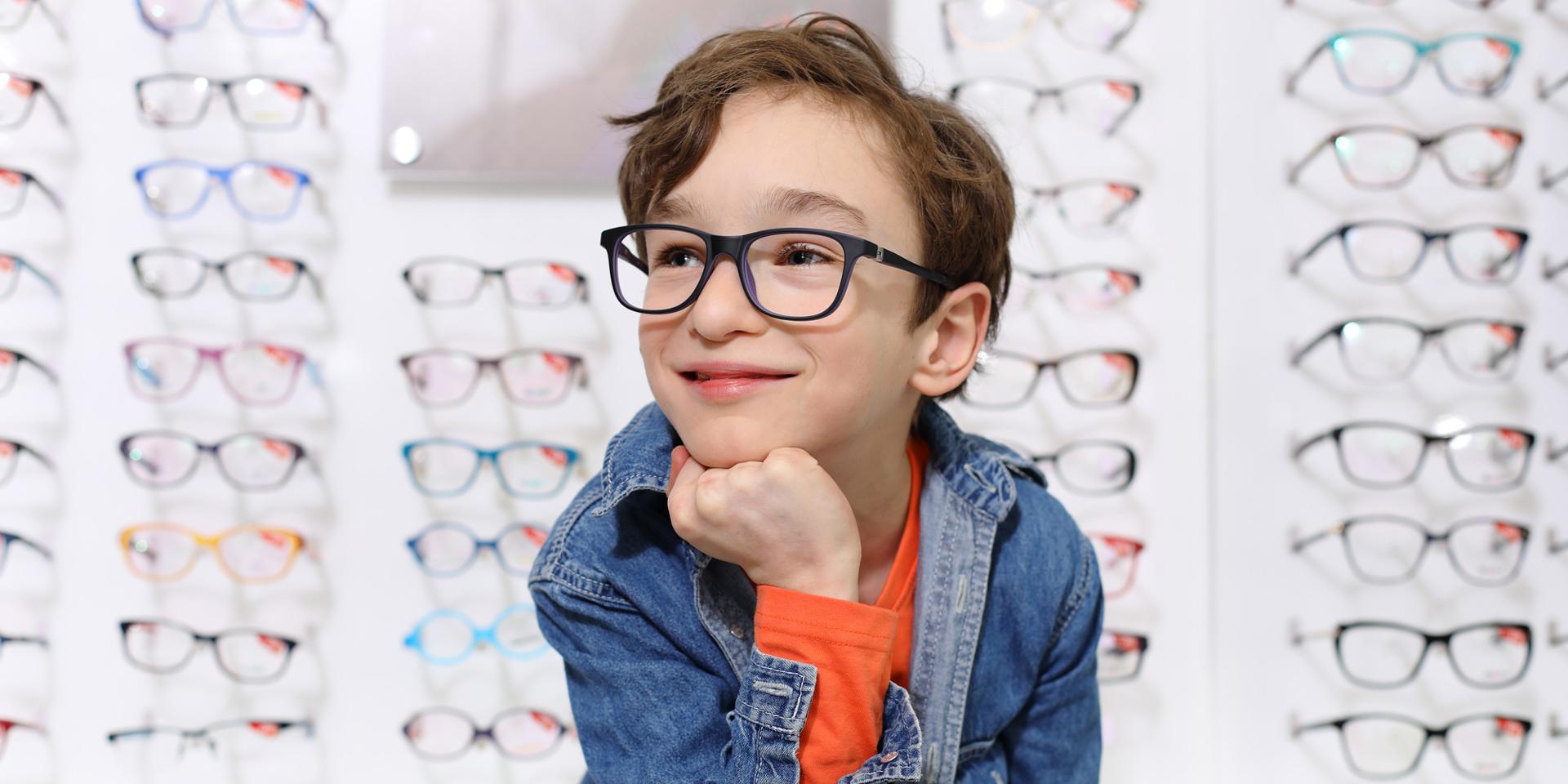
Kids' Glasses in Brooklyn — Sized and Fitted So They Actually Stay On
Bridge width, temple length, and pupillary distance measured directly — not estimated from age ranges. Walk in to 810 Kings Highway with your child and the written Rx. No appointment needed.
A correctly fitted children's frame doesn't slide, pinch, or shift during activity. That's the entire goal.
When a child receives a school screening referral or a new prescription from their eye doctor, the next step is finding a frame that fits their specific face. Not the average face for their age. Not the size printed on the temple arm. Their actual bridge width. Their actual pupillary distance. Their actual temple length.
These measurements change the outcome. A frame with the wrong bridge sits low on the nose from day one. The optical centers no longer line up with your child’s pupils. They squint. They push the frame up constantly. And within a few weeks, the glasses come off and stay off. That’s not a behavior problem — that’s a fit problem a proper measurement would have caught.
Some of the children fitted here in the 1990s now bring their own kids in.
Pediatric prescriptions vary widely. Bridge widths among children of the same age can differ by six millimeters or more. A frame that fits an eight-year-old with a low nasal bridge perfectly may be completely wrong for a classmate of the same age with a narrower face and higher bridge.
The Kings Highway corridor in Brooklyn zip codes 11223 and 11204 includes a large number of families whose children present with moderate to high myopia — a pattern that requires specific lens expertise alongside the fitting work. These cases often need high-index lens materials to keep lens thickness manageable; see the high-index lenses page for the material side of the equation. AR coating is covered on the lens coatings page.
Fitting children’s eyewear at this Brooklyn address
Authorized to dispense in New York State
Pediatric frame fitting & lens material expertise
Bridge, pupillary distance, and temple length — measured directly on your child's face, never estimated from age ranges.
Children’s faces vary significantly even within the same age group — bridge widths can differ by six millimeters or more among classmates. Three measurements anchor every pediatric fitting at Viewtopia. None of them are guessed.
How the frame sits on the nose
Measured directly with a millimeter ruler on your child’s actual nose, not estimated from the size printed on the temple arm. A frame four millimeters too wide sits low from day one — the child squints, pushes it up, and eventually leaves it on the nightstand. The right bridge is the difference between glasses that work and glasses that don’t.
Monocular, never averaged
Each eye measured separately, not as a single binocular number. Monocular PD matters more in pediatric cases — particularly for children with anisometropia, where the two eyes have meaningfully different prescriptions. The optical center of each lens must align with that eye’s actual pupil position, independently.
Frame front to ear, accurately
Assessed against your child’s actual ear position and head width. Too short and the temple pinches behind the ear; too long and the frame slides forward all day. Children also need a proper curve behind the ear — straight temples that haven’t been adjusted are why so many kids’ frames rock forward and back.
A frame is selected from options that meet these three measurements — not from the full rack. The fitting precedes the frame choice. The frame choice precedes the lens material decision. The sequence matters as much as any individual step.
The child looks up and says, "These don't fall down." That's a fit problem a proper measurement caught.
Most children who won’t wear their glasses are dealing with a fit problem, not a compliance problem. A frame four millimeters too wide. Temples bent straight, no proper curve behind the ear. The frame rocking forward and back with every movement. A pair of glasses a child will actually wear is worth every extra minute of careful measurement.
Measurement first. Frame selection second. Lens specification last.
Pediatric frame fitting is more exacting than adult fitting because children’s faces vary significantly even within the same age group. Every children’s fitting at Viewtopia follows the same six-step sequence.
Direct Bridge Measurement
Measured with a millimeter ruler on your child’s actual nose. Not estimated from the size on the temple arm. Not interpolated from age. Bridge width is the single most important pediatric fitting variable — it determines whether the frame stays where it’s supposed to.
Monocular Pupillary Distance
Each eye measured separately. For children with anisometropia, amblyopia risk, or accommodative esotropia, this distinction is consequential — the optical center of each lens must align independently with each eye’s pupil. Binocular averaging is not accurate enough.
Temple Length & Ear Position
Assessed against your child’s ear position and head width. Spring hinges flex outward when a child removes glasses with one hand — generally the right default for active kids. Flexible TR-90 nylon is a practical option for younger children, with the caveat that very high-power lenses need a stiffer frame.
Frame Selection From Measured Options
The frame is chosen from options that meet the three measurements — not from the full rack. Inventory includes adjustable nose pads for low bridges, smaller widths for narrow faces, and shorter temples for children who need a shorter reach to the ear.
Lens Material Specification
Polycarbonate is the baseline — it meets ANSI Z87.1 impact resistance, the same benchmark as industrial safety eyewear. For stronger prescriptions where polycarbonate’s optical quality becomes a factor, Trivex is recommended directly. The lens material decision happens after frame selection, not before.
Adjustment & Follow-Up
After the lenses are installed, the frame is adjusted for final fit — bridge contact, temple curve, ear position, pantoscopic tilt. Follow-up adjustment is available at no charge if the fit shifts over the first few weeks. Children’s frames take more abuse than adult ones; periodic adjustment keeps them in working position.
A pair of glasses a child will actually wear is worth every extra minute of careful measurement.
Three pediatric cases where fitting precision changes the clinical result — not just the comfort.
Children’s prescriptions are not simply smaller versions of adult prescriptions. The fitting decisions that follow from the prescription can be more consequential than parents expect — especially in these three cases.
Anisometropia
When one eye has a noticeably stronger prescription than the other, the two lenses produce images of slightly different sizes. The brain has to reconcile those images. In children, whose visual systems are still developing, poorly managed anisometropia can interfere with that development.
Getting the optical centers precisely aligned with each pupil — monocular PD measurement, not a single binocular number — matters more in these cases, not less. Frame shape and lens depth also affect how the resulting thickness difference between the two lenses is managed.
Accommodative Esotropia
Some children have an inward eye turn that is driven by the focusing effort their eyes exert to see clearly. A correctly prescribed pair of glasses — properly fitted so the optical centers actually align — can reduce or eliminate that eye turn.
A poorly fitted frame, where the optical centers are shifted even a few millimeters from the pupil centers, undermines the therapeutic effect entirely. In these cases the glasses are doing real clinical work, not just optical correction. The fitting has to support that.
High Myopia
The Kings Highway corridor in zip codes 11223 and 11204 includes a large number of children presenting with moderate to high myopia. These cases often need high-index lens materials to keep lens thickness manageable, and frames selected with the optical zone geometry in mind — not just aesthetics.
For higher prescriptions, Trivex or high-index lenses replace standard polycarbonate. Frame selection considers minimum blank size requirements that affect edge thickness. See the high-index lenses page for the material side of the equation.
Find us on Kings Highway.
Steps from the Kings Highway B and Q station, in the heart of southern Brooklyn. No appointment needed — walk in with your current prescription during business hours.
810 Kings Highway
Bet. East 8th & 9th
Brooklyn, NY 11223
Monday – Wednesday10:00 AM – 6:00 PM
Thursday10:00 AM – 7:00 PM
Friday10:00 AM – 1:00 PM
SaturdayClosed
Sunday11:00 AM – 5:00 PM
Gravesend · Midwood · Bensonhurst · Sheepshead Bay · Flatbush · Bay Ridge · Manhattan
The eye exam comes first.
Then bring the written Rx to 810 Kings Highway.
A school vision screening referral is not a prescription — it’s a signal that your child needs an eye exam from a licensed optometrist or ophthalmologist. Once you have the written Rx, walk in with your child during regular business hours.
Abe is present for every fitting — no hand-off to a sales associate after a quick measurement. Call 718-676-0260 with questions, or walk in to 810 Kings Highway, Brooklyn, NY 11223. VSP and EyeMed out-of-network benefits may apply.
NYS License #005762-01 · ABO-NCLE Certificate #018067
Frequently
asked.
Common questions about prescription differences between eyes, age minimums, prescription change frequency, frame adjustments, low-bridge fitting, and evaluating existing glasses. If your question isn’t here, call or walk in.